

Verifying FDA Food Facility Registration Safety Marks for a Global Leading Fresh Fruit Containers Brand YiTo Pack

Why Food Contact Safety Documentation Demands Verification Beyond Visual Inspection
A "FDA compliant" stamp on a quotation tells a buyer nothing verifiable. The phrase carries no regulatory definition, since FDA compliance for food contact materials operates through multiple distinct mechanisms: facility registration under the Bioterrorism Act, product-level conformance with 21 CFR 174 through 186, and material-specific clearance for substances used in food contact applications. Conflating these creates the false impression of comprehensive compliance where only one element may actually exist.
Food contact safety also differs fundamentally from general product safety in regulatory terms. A container that meets mechanical durability standards may still leach substances into the food it holds, particularly under elevated temperature, acidity, or fat content conditions that fresh fruit applications routinely produce. Citrus fruits, berries with high anthocyanin content, and tropical fruits with elevated oil content each interact with packaging materials differently, which makes generalized compliance claims insufficient.
The liability cascade matters because importers, not manufacturers, typically absorb the consequences when destination-market testing reveals migration exceedances. A single failed batch can trigger recall obligations, retailer delisting, and regulatory penalties that exceed the entire commercial value of the import program. Fresh fruit applications carry higher scrutiny than dry goods packaging precisely because moisture and acidity accelerate migration phenomena that drier products mask.
FDA Food Facility Registration — What the Number Means and How to Verify It
FDA Food Facility Registration operates under the Bioterrorism Act of 2002 and the Food Safety Modernization Act (FSMA). The registration applies to facilities that manufacture, process, pack, or hold food for U.S. consumption, including food contact materials. Each registered facility receives a unique registration number that must be renewed biennially in even-numbered years.
Critically, the registration number differs from product-level FDA compliance claims. A facility registration confirms that the manufacturing site has notified the FDA of its operations, but it does not certify that any specific product meets food contact safety requirements. Product-level compliance requires separate documentation, typically including substance-specific clearances under 21 CFR and migration test reports demonstrating compliance under intended use conditions.
The FDA maintains a registration database that allows authorized parties to confirm active registration status. Buyers conducting verification should request the supplier's exact registration number and corresponding facility address, then cross-reference against FDA records through appropriate channels. Common misrepresentations include expired registrations presented as current, registration numbers belonging to unrelated entities, and facility addresses that do not match the production site actually fulfilling orders. Each of these gaps becomes visible during authentication but invisible without it.
LFGB Conformity — German Food Contact Standards and Migration Testing
LFGB, the German Food and Feed Code, sets food contact material standards through Sections 30 and 31. The framework often applies more stringent test parameters than general EU requirements, which makes LFGB compliance a useful indicator of supplier documentation depth even for buyers outside Germany.
Migration testing under LFGB requires two distinct measurements. Overall migration testing measures the total mass of substances transferred from packaging to food simulant under defined conditions, typically expressed in milligrams per square decimeter of contact area. Specific migration testing measures individual substances of regulatory concern, with limits varying by substance and intended use category.
Accredited German laboratories structure LFGB test reports with specific elements that buyers can authenticate: laboratory accreditation number, test method references, food simulant specifications, exposure conditions, and detailed results with measurement uncertainty. Verification methods include cross-referencing the issuing laboratory against German accreditation databases such as DAkkS, which lists currently accredited testing facilities. Reports from unaccredited laboratories, or from accredited facilities whose accreditation has lapsed, carry significantly reduced evidentiary weight despite often appearing identical at first glance.
EU 10/2011 and Framework Regulation 1935/2004 — The Layered European System
European food contact safety operates through a layered regulatory structure. Framework Regulation 1935/2004 sets foundational requirements that apply to all food contact materials, including the general principle that materials must not transfer substances to food in quantities that could endanger health or change food composition unacceptably.
EU 10/2011 establishes specific requirements for plastic food contact materials, including the positive list of authorized substances, overall migration limits, and specific migration limits for individual substances. The regulation has been amended multiple times since enactment, which means buyers should verify that supplier documentation references current versions rather than superseded amendments.
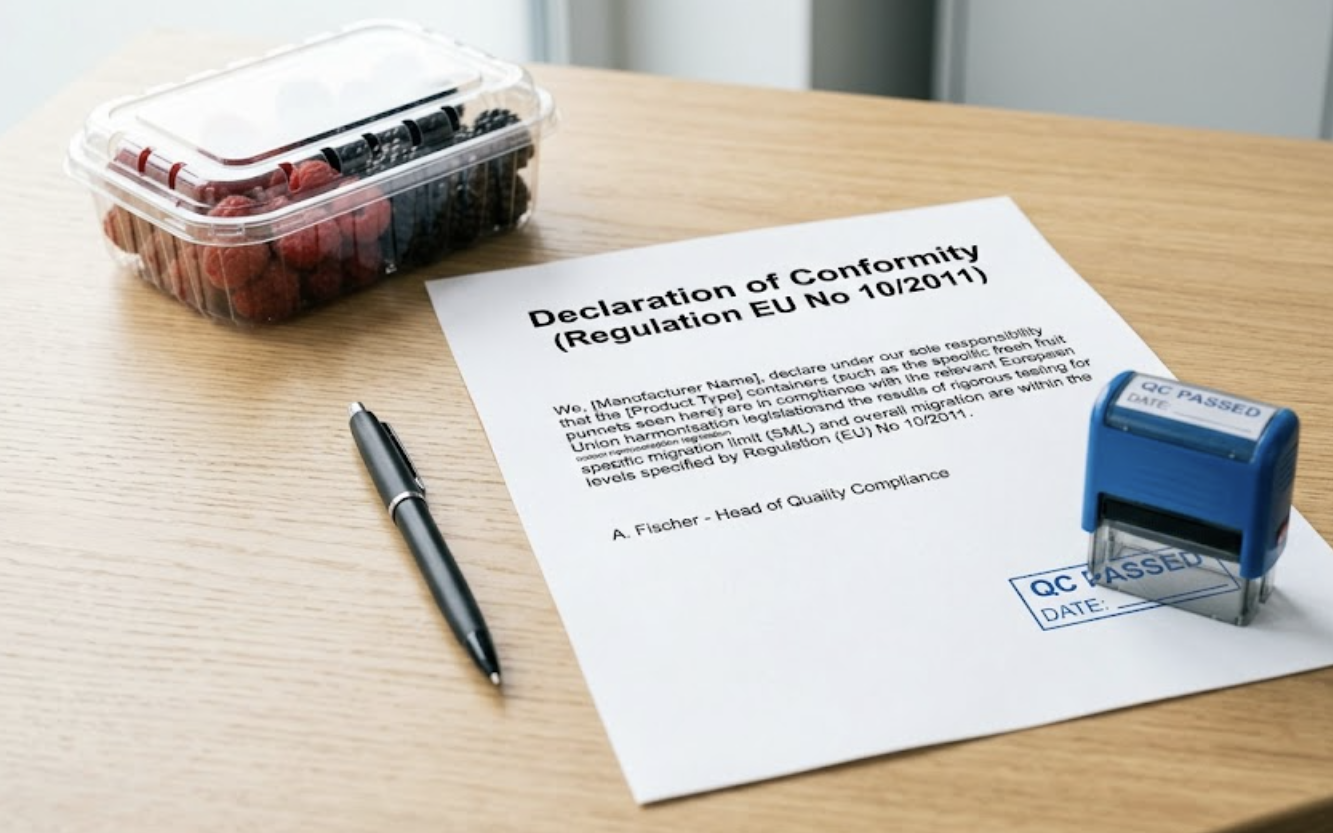
A valid Declaration of Conformity under EU 10/2011 must contain specific elements: identification of the material, intended food contact applications, compliance statements referencing applicable regulations, information on substances with restrictions, and verification that overall and specific migration limits are met. Declarations lacking these elements, regardless of how official they appear, fail to satisfy regulatory requirements.
YiTo Pack structures its EU food contact documentation around Declaration of Conformity templates that include each required element, with batch-specific test data referenced rather than generic compliance claims. This approach allows buyers to authenticate documentation against EU regulatory requirements rather than accept supplier formatting at face value. Substance-specific migration limits relevant to fresh fruit containers include monomers, additives, and processing aids that may transfer under acidic or aqueous conditions characteristic of berry, citrus, and stone fruit applications.
Practical Verification Procedures Buyers Should Apply
Authentication of food contact documentation follows a procedural sequence that buyers can apply systematically. The first step requests complete documentation from suppliers, including FDA registration numbers, LFGB test reports, EU Declarations of Conformity, and any supporting migration test data. Suppliers who respond with comprehensive documentation packages signal a different operating standard than those who provide generic compliance assertions.
Cross-referencing supplier-provided certificates against issuing authority databases constitutes the second verification step. FDA registration numbers can be confirmed through appropriate FDA channels, LFGB test laboratories can be authenticated through DAkkS or equivalent accreditation databases, and EU Declarations of Conformity can be cross-checked for required elements against current regulatory text.
Several red flags indicate potential document forgery or misrepresentation. Test reports lacking laboratory contact information, missing accreditation numbers, or referencing superseded regulatory versions warrant additional scrutiny. Declarations of Conformity that omit substance-specific information, generic certificates that cover entire product categories without batch reference, and documentation translated from languages other than the issuing authority's official language all suggest verification gaps worth investigating.
Independent laboratory re-testing adds an additional verification layer for high-stakes procurement scenarios. The cost of commissioning third-party migration testing on supplier samples typically runs a fraction of the commercial exposure carried by a contaminated import program. For buyers exploring related categories such as biodegradable vacuum seal bags for fresh produce preservation, the same verification discipline applies, since vacuum packaging creates concentrated food contact conditions that amplify migration concerns.
How Established Manufacturers Build Verification Infrastructure Into Their Documentation Workflow
Established manufacturers distinguish themselves through documentation infrastructure that supports per-batch verification rather than annual product-level certification alone. Per-batch food contact testing, while not always regulatorily required, provides traceability that buyer-side audits and retailer compliance reviews increasingly demand. Annual certification confirms that a product line was compliant at one moment in time; batch-level documentation confirms that specific shipments maintained that compliance.
Accredited third-party laboratories play a central role in supplier documentation chains. Manufacturers without established laboratory relationships often produce documentation that appears compliant but lacks the independent verification that regulatory frameworks contemplate. Buyers conducting supplier qualification should examine which laboratories the supplier uses, whether those laboratories maintain current accreditation, and whether test reports reference specific production batches rather than generic product references.
YiTo Pack maintains traceable food contact documentation across its fresh fruit container product lines, with test reports linked to specific production batches and Declaration of Conformity templates updated as regulatory frameworks evolve. This approach treats food contact safety as an ongoing operational discipline rather than a one-time certification milestone. The distinction between catalog-level compliance claims and shipment-level documentation often determines whether a buyer's program survives destination-market scrutiny or absorbs the costs of failed verification.
Fresh fruit container sourcing in 2026 rewards buyers who treat food contact safety verification as a procedural discipline rather than a paperwork formality. The combination of FDA registration verification, LFGB conformity authentication, and EU Declaration of Conformity validation creates a verification framework that protects against the documentation gaps frequently encountered in fresh produce container sourcing. YiTo Pack provides documentation infrastructure and verification support for buyers conducting due diligence on fresh produce packaging suppliers, with further information accessible through https://www.yitopack.com/.
HuiZhou YITO Packaging Co., Ltd.
HuiZhou YITO Packaging Co., Ltd.
159 7508 6317
email us here
Visit us on social media:
LinkedIn
Instagram
Facebook
YouTube
Legal Disclaimer:
EIN Presswire provides this news content "as is" without warranty of any kind. We do not accept any responsibility or liability for the accuracy, content, images, videos, licenses, completeness, legality, or reliability of the information contained in this article. If you have any complaints or copyright issues related to this article, kindly contact the author above.
