

Your food and beverage industry news from the United States
Provided by AGP
Agricultural Biotechnology Market 2026: $159.2 Billion Size, 5.81% CAGR and Gene-Editing Breakthroughs
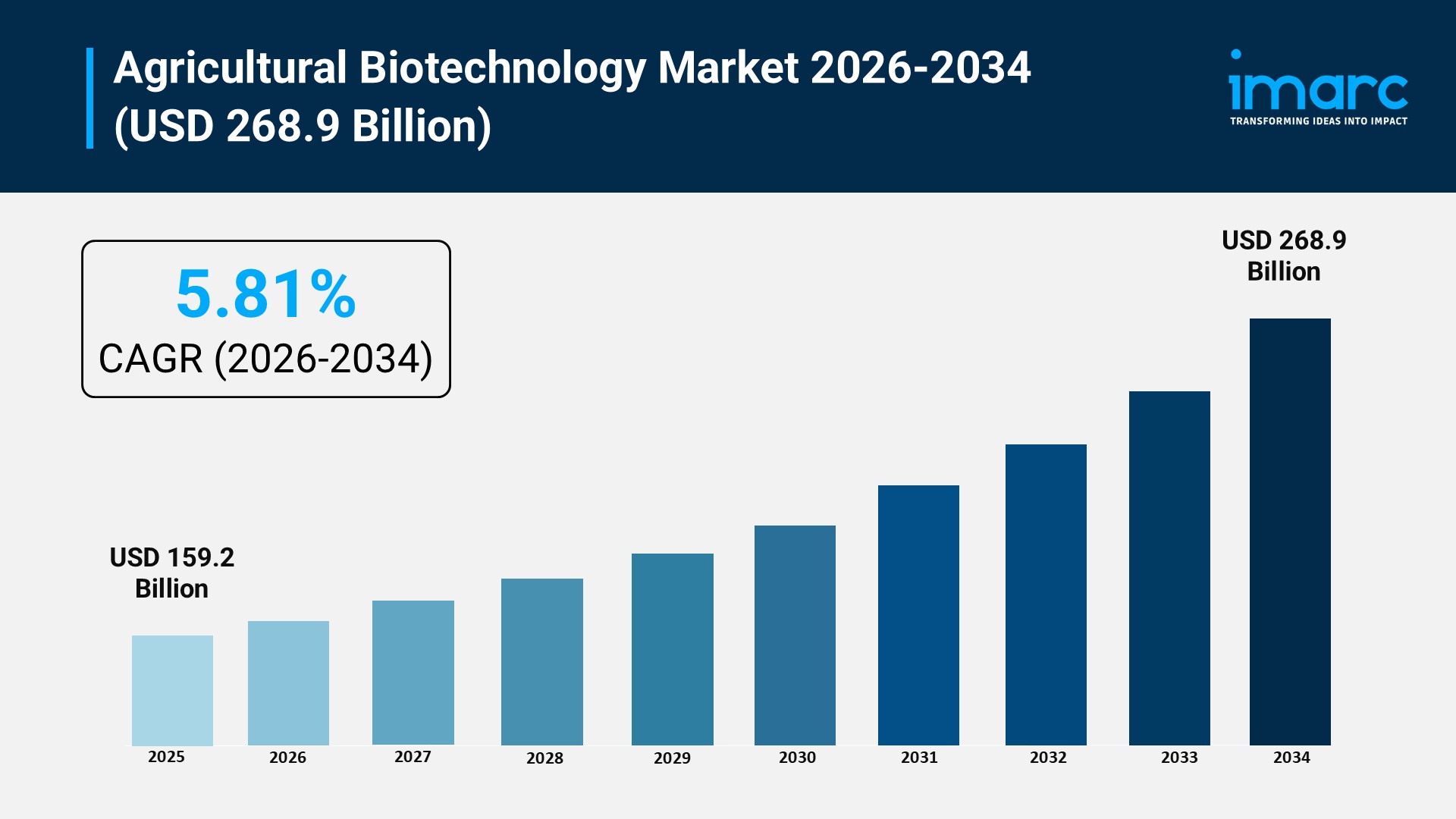
Agricultural Biotechnology Market Graph 2026
The global agricultural biotechnology market is projected to reach USD 268․9 Billion by 2034
SHERIDAN, WY, UNITED STATES, May 18, 2026 /EINPresswire.com/ -- The agriculture biotechnology market is no longer a fringe conversation happening in university labs. It is a USD 159.2 Billion commercial reality in 2025, and the businesses that treat it as such will be the ones capturing disproportionate value over the next decade.The global agricultural biotechnology market is projected to reach USD 268․9 Billion by 2034‚ witnessing a CAGR of 5․81% from 2026 to 2034․ The topline number is not the only enticing part of the agricultural biotechnology opportunity for decision-makers․ Instead‚ it is the confluence of a projected global population of nearly 10 billion‚ climate change impacts already affecting agricultural productivity in many regions‚ and a policy environment much more in tune with underlying science than in the past․ Now the question is no longer whether agbiotech will transform the global food system․ The question‚ though‚ is where the revenue opportunities are․
Download a sample copy of the report: https://www.imarcgroup.com/agricultural-biotechnology-market/requestsample
What Is Driving the Agricultural Biotechnology Market in 2026 and Beyond?
The agriculture biotechnology market sits at the intersection of food security, sustainability mandates, and precision science. Several reinforcing demand drivers are accelerating its expansion.
The increased food demand of a growing world population and loss of farmland and water resources for irrigation cannot be addressed by conventional agriculture alone․ Genetically modified crops as well as modern seeds and crop protection products developed on the basis of biotechnology can help increase average yields per hectare with fewer inputs․
From the moment of its public release‚ CRISPR‚ along with other novel gene editing technologies‚ has had the potential to greatly accelerate the process of producing new varieties․ Unlike customary plant breeding‚ which takes years or decades‚ gene editing allows for the rapid introduction of targeted changes to plant genomes․ The result is crops that have improved properties‚ such as disease resistance‚ drought tolerance‚ and improved nutritional value․ For example‚ the Kal91․3 potato developed by Michigan State University through genetic engineering has lower storage temperatures and better potato chip quality․ The U․S․ Department of Agriculture opted to exempt this variety from biotechnology regulation‚ which simplifies the regulatory process for gene-edited products․
Regulatory and consumer pressure to adopt sustainability and regenerative agriculture practices is leading companies all along the value chain to invest in practices that improve soil health‚ sequester carbon‚ and reduce chemical inputs․ For example‚ in July 2024‚ ADM and Smucker announced a partnership to advance regenerative agriculture practices on 20‚000 acres per year of peanuts grown in the United States‚ a demonstration of how far sustainability has become a part of doing business versus simply a marketing tool․
Government incentives and digital agricultural infrastructure have a role to play in the demand equation․ India has introduced Digital Public Infrastructure in agriculture with Rs 1․52 lakh crore set aside for agriculture and allied sectors‚ providing the digital infrastructure required for scaling biotech innovations․
Agricultural Biotechnology Market Segmentation: Where Is the Revenue Concentrated?
For businesses evaluating market entry, expansion, or portfolio allocation, understanding where demand concentrates is essential. The agriculture biotechnology market segments across three primary dimensions: organism type, technology, and application.
By Organism Type
The market covers plants, animals, and microbes, with each further segmented into conventional techniques, established genetic modification, and new breeding techniques.
• Plants represent the largest segment by a significant margin. The dominance of plant biotechnology reflects the outsized commercial value of genetically modified crops like corn, soybeans, and cotton. Innovations in CRISPR and gene editing are accelerating the development of crop varieties with improved yield, pest resistance, and climate resilience. BASF's strategic focus on integrated agricultural solutions, with a projected peak sales potential exceeding EUR 7.5 billion in the next decade, underscores the scale of investment flowing into plant biotech.
• Animals represent a growing but more regulated segment, with biotechnology applications spanning livestock health, feed optimization, and genetic improvement for disease resistance.
• Microbes are gaining traction as the foundation for biofertilizers, biopesticides, and soil health products, aligning with the broader shift toward sustainable and regenerative farming.
By Technology
The technology landscape includes genome editing, synthetic biology, genetic engineering, marker-assisted breeding, plant breeding, germplasm, and others.
Synthetic biology holds the largest share in the agricultural biotechnology market. Its dominance stems from the transformative potential of combining genetic engineering, CRISPR, and synthetic DNA to create organisms with precisely engineered traits. In May 2024, BASF Agricultural Solutions and Anhui Huaheng Biotechnology partnered to develop bio-stimulant products leveraging synthetic biology for the Chinese market, establishing a joint lab to support product development.
Genome editing represents the fastest-moving frontier, with CRISPR-Cas9 becoming the workhorse technology for targeted crop improvement across major agricultural companies globally.
By Application
Application segments include vaccine development, transgenic crops and animals, antibiotic development, nutritional supplements, flower culturing, and others.
Vaccine development leads the market, driven by the critical need to protect livestock and crops against diseases that threaten food supply chains. IIT Guwahati's transfer of recombinant Swine Fever Virus vaccine technology to BioMed Pvt. Ltd. in March 2024 exemplifies how agricultural biotech is delivering targeted, cost-effective solutions for disease control.
Transgenic crops and animals remain a high-volume application, with GM crop adoption continuing to expand across major agricultural economies. Nutritional supplements and antibiotic development round out the application portfolio, each serving distinct but growing demand channels.
Which Region Leads the Agricultural Biotechnology Market?
North America dominates the agriculture biotechnology market, holding the largest regional share. The region's leadership reflects a combination of advanced research infrastructure, heavy R&D investment, favorable regulatory frameworks, and widespread adoption of genetically modified crops. The presence of major industry players and a well-established supply chain reinforce North America's competitive position. Bayer's June 2024 announcement of plans to launch ten blockbuster products over the next decade, each targeting over EUR 500 million in revenue, with a goal of scaling regenerative agriculture across 400 million acres globally, illustrates the ambition level driving North American agritech.
Asia Pacific is the fastest-growing regional market, propelled by favorable government initiatives, expanding agricultural modernization programs, and rising food security concerns. India and China are leading the charge, with significant public investment in biotech research and digital agriculture infrastructure.
Europe focuses on sustainable and organic farming, which shapes its biotech development trajectory. While the regulatory environment for GMOs remains more restrictive than in North America, gene-editing technologies are gaining acceptance, and the region's emphasis on sustainability creates strong demand for biofertilizers, biopesticides, and precision breeding.
Latin America benefits from vast agricultural lands and favorable climates, making it a natural market for biotech crop adoption. Brazil and Mexico are primary growth engines.
The Middle East and Africa represent emerging markets where biotechnology addresses acute food security challenges, with rising investments in research infrastructure creating long-term growth potential.
Speak to an analyst: https://www.imarcgroup.com/request?type=report&id=11685&flag=C
How Are Key Players Shaping the Competitive Landscape?
The agricultural biotechnology market features a concentrated competitive core surrounded by a dynamic ecosystem of specialized firms and startups. Major players include ADAMA Ltd. (Syngenta Group), BASF SE, Bayer AG, DowDuPont, LGC Biosearch Technologies, Performance Plants Inc., and Yield10 Bioscience Inc.
Bayer AG maintains its position as a market leader through its Crop Science division, which integrates genetically modified seeds, digital farming platforms, and regenerative agriculture initiatives. The company's DEKALB, AsGrow, and Deltapine seed brands serve as anchor products in major agricultural markets.
BASF SE continues to invest aggressively in biological and biotechnology-based crop protection. In October 2023, BASF announced plans to invest a high double-digit million euro amount in a new fermentation plant at its Ludwigshafen site, targeting production of biological crop protection products starting in the second half of 2025.
Syngenta Group has taken an open-innovation approach to gene editing. In June 2024, Syngenta opened rights to selected genome-editing and breeding technologies for global academic research through its Shoots by Syngenta platform, offering improved CRISPR-based technologies to accelerate crop improvement.
Corteva Agriscience emphasizes CRISPR-Cas technology to accelerate next-generation crop trait development. The company's CropOS platform integrates data science, genomics, AI, and machine learning to shorten breeding cycles and enhance efficiency.
These companies compete not just on product pipelines but on the ability to integrate biotech innovations with digital agriculture, sustainability frameworks, and farmer-facing service models.
What Challenges Could Slow Market Expansion?
The agriculture biotechnology market faces real headwinds that businesses must factor into their strategic planning.
Regulatory complexity and inconsistency remain the most persistent barriers․ Approvals in North America are relatively straightforward‚ whereas GMO legislation in Europe remains strict․ On the market side‚ many developing markets lack harmonized regulatory frameworks for gene-edited products which creates uncertainty and compliance costs․
Public resistance of GMOs still affects consumer opinion in Europe and parts of Asia‚ but there is a consensus of safety among approved biotech products‚ despite some gaps in perception․ It takes conscientious effort to inform consumers and provide clear labeling․
The high Research and Development (R&D) costs and time associated with developing and commercializing a new biotech crop trait tend to give an incumbent with large resources an important competitive advantage over smaller firms seeking to enter the market․
The ethical debate surrounding genetic modification presents an additional social license risk as gene-editing expands from plants to animals and microbes․
But each of these challenges also creates opportunities․ The need for a non-GMO biotech product‚ increasing regulatory acceptance of gene editing as distinct from a customary GMO‚ and the use of artificial intelligence to drive down costs and timelines as research and development becomes less tied to wet lab work could incentivize firms to pursue new options at the science-market access interface․
Request Customization: https://www.imarcgroup.com/request?type=report&id=11685&flag=E
The Strategic Takeaway
The market size of the agricultural biotechnology sector is already very large at USD 159․2 Billion and is projected to grow unabated by any cyclical forces to USD 268․9 Billion by 2034․ Population growth is irreversible; climate stress will not go away․ Companies that have built their business models around those certainties‚ investing in gene editing‚ biologicals‚ digitalization and new market access‚ will write the next chapter of global food production․
About IMARC Group
IMARC Group is a leading global market research company providing data-driven insights and expert consulting services to businesses seeking to achieve their strategic objectives. With a multi-disciplinary team of industry experts, IMARC delivers thorough, reliable market intelligence across sectors including agriculture, chemicals and materials, food and beverages, healthcare, and energy.
Elena Anderson
IMARC Services Private Limited
+1 201-971-6302
email us here
Legal Disclaimer:
EIN Presswire provides this news content "as is" without warranty of any kind. We do not accept any responsibility or liability for the accuracy, content, images, videos, licenses, completeness, legality, or reliability of the information contained in this article. If you have any complaints or copyright issues related to this article, kindly contact the author above.
