

Postbiotic Fermented Barley Extract Market Forecast 2026: Global Market to Reach USD 840.0 Million by 2036 at 11.4% CAGR
Postbiotic Fermented Barley Extract Industry Size
Postbiotic fermented barley extract market grows on clinical validation, stable metabolite demand, & rising adoption in supplements, skincare & functional foods
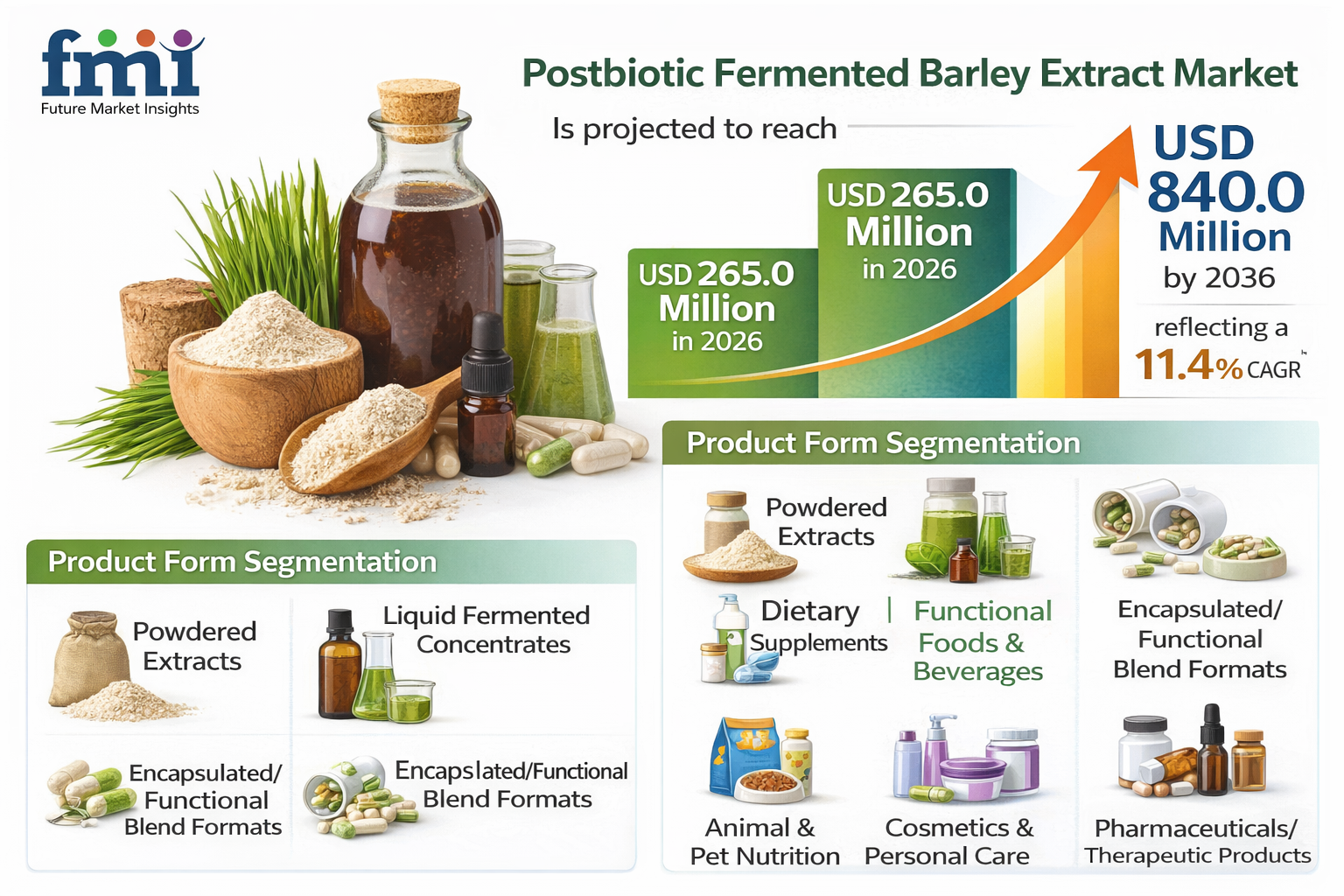
NEWARK, DE, UNITED STATES, March 3, 2026 /EINPresswire.com/ -- The global postbiotic fermented barley extract market is entering a clinically driven growth phase. Valued at USD 240.0 million in 2025, the market is projected to reach USD 265.0 million in 2026 and expand significantly to USD 840.0 million by 2036, registering a CAGR of 11.4%.
Unlike live probiotics, postbiotic fermented barley extracts offer shelf-stable metabolite compounds backed by measurable efficacy. Regulatory committees are increasingly mandating clinical documentation instead of generalized gut-health positioning. Ingredient standardization is resetting procurement benchmarks across supplement and functional food pipelines.
Explore trends before investing – request a sample report today! https://www.futuremarketinsights.com/reports/sample/rep-gb-32133
The market will generate an absolute dollar opportunity of USD 575.0 million over the next decade. Growth remains incremental and compliance-led rather than speculative. Supply-side stability is improving as global cereal harvest projections reached 153.74 million metric tons in February 2026, encouraging long-term procurement contracts and capacity locking agreements.
Market Definition and Commercial Scope
Postbiotic fermented barley extract refers to non-viable bacterial metabolites derived through controlled microbial digestion of barley substrates. Industrial stabilization enables integration into dietary supplements, cosmetics, pharmaceuticals, and animal nutrition without cold-chain dependency.
The study includes:
• Powdered extracts, liquid concentrates, and encapsulated blends
• Applications in supplements, functional foods, cosmetics, pharmaceuticals, and animal nutrition
• Revenue generated from deliberate metabolite concentration processes
Live probiotic strains, unfermented malt derivatives, and generic barley flour remain excluded from valuation models.
Market Value Snapshot
The industry is expected to reach USD 265.0 million in 2026 and expand to USD 840.0 million by 2036, reflecting steady 11.4% CAGR expansion. Procurement-driven specification upgrades, rather than consumer hype, are accelerating commercial integration.
According to Nandini Roy Choudhury, Principal Consultant for Food & Beverage at FMI, metabolite transparency will define long-term category credibility. Brands must clearly quantify beta-glucans, short-chain fatty acids, peptides, and cell wall fragments supporting functional claims. Generic “fermented” positioning will not sustain premium pricing.
Product Form Insights
Powdered extracts account for 48% share in 2026. Manufacturers prefer dehydrated formats because they:
• Eliminate cold-chain logistics
• Reduce moisture-related formulation instability
• Integrate directly into capsule and tablet manufacturing
• Maintain stable beta-glucan concentrations between 2.5% and 11.3%
Strategic production partnerships formed in early 2026 are expanding commercial drying capacity. Dehydrated ferment filtrates move efficiently through high-speed encapsulation lines, lowering secondary processing overhead.
Application Dynamics
Dietary supplements represent 37% of total volume in 2026. Brands are reformulating immunity and gut-health portfolios by replacing live cultures with metabolite-rich extracts that survive gastric processing without viability losses.
Skincare manufacturers are simultaneously incorporating clinically validated anti-inflammatory compounds into inner beauty formulations. Institutional buyers now demand certified indications to secure budget approvals within single fiscal cycles.
Regional Outlook
Growth dispersion mirrors regulatory adoption curves.
The United States is projected to expand at 12.2% CAGR through 2036 as structured clinical validation protocols strengthen procurement confidence. Forward contracting strategies intensified after harvest volatility reduced barley output in late 2025.
Germany is forecast to grow at 11.0% CAGR, benefiting from stringent quality certifications and pharmaceutical-grade documentation pathways. The United Kingdom follows closely at 10.8%, supported by tighter manufacturing compliance frameworks.
In Asia-Pacific, China is expected to expand at 11.7% CAGR as functional beverage demand accelerates capacity upgrades. India is projected to grow at 11.4% CAGR, driven by preventive healthcare spending and improved ingredient compliance awareness.
Latin America is emerging steadily, with Brazil projected to grow at 10.5% CAGR as livestock operators and supplement brands modernize ingredient sourcing.
Market Drivers and Constraints
Clinical documentation is the primary catalyst. Over 2,215 recorded patents validate targeted metabolite functionality, forcing specification upgrades across nutrition and medical food segments.
However, agricultural dependency remains a constraint. Regional droughts expose extractors without integrated supply agreements to margin volatility. Facilities with audited extraction capabilities and direct grain contracts are better positioned to withstand harvest fluctuations.
Opportunities are expanding in:
• Mental wellness and immunity convergence formulations
• High-bioavailability extracts commanding premium pricing
• Direct-to-consumer concentrated formats introduced at Expo West 2026
Competitive Landscape
Leading companies including Cargill, Incorporated; Archer Daniels Midland (ADM); Kerry Group PLC; DSM-Firmenich AG; Sami-Sabinsa Group; Postbiotica S.r.l.; and MCLS Europe B.V. are prioritizing advanced analytical profiling, vertical integration, and clinical validation partnerships.
In November 2025, Cargill Animal Nutrition & Health expanded its Austria micronutrition facility capacity by 50%, reflecting long-term confidence in metabolite-driven ingredient demand.
Strategic Takeaways for Executives
• Lock long-term grain procurement contracts
• Invest in randomized clinical validation trials
• Prioritize dehydrated extract production
• Implement advanced metabolite profiling for batch consistency
The postbiotic fermented barley extract market is evolving into a compliance-centered, clinically documented ingredient category. Long-term success will depend on transparency, validated efficacy, and supply chain resilience rather than marketing claims alone.
Why FMI: https://www.futuremarketinsights.com/why-fmi
Explore FMI’s Extensive Coverage in the Food and beverage Domain:
Customized Premix Market: https://www.futuremarketinsights.com/reports/customized-premixes-market
Beta-Glucans Market: https://www.futuremarketinsights.com/reports/beta-glucans-market
Vanillin Market: https://www.futuremarketinsights.com/reports/vanillin-market
Gum Arabic Market: https://www.futuremarketinsights.com/reports/gum-arabic-market
Astaxanthin Market: https://www.futuremarketinsights.com/reports/astaxanthin-market
Sudip Saha
Future Market Insights Inc.
+1 347-918-3531
email us here
Legal Disclaimer:
EIN Presswire provides this news content "as is" without warranty of any kind. We do not accept any responsibility or liability for the accuracy, content, images, videos, licenses, completeness, legality, or reliability of the information contained in this article. If you have any complaints or copyright issues related to this article, kindly contact the author above.
