

Low-Fermentability Dietary Fibers Market Valuation, ROI Potential & Long-Term Growth Prospects 2026–2036
Low-Fermentability Dietary Fibers Market
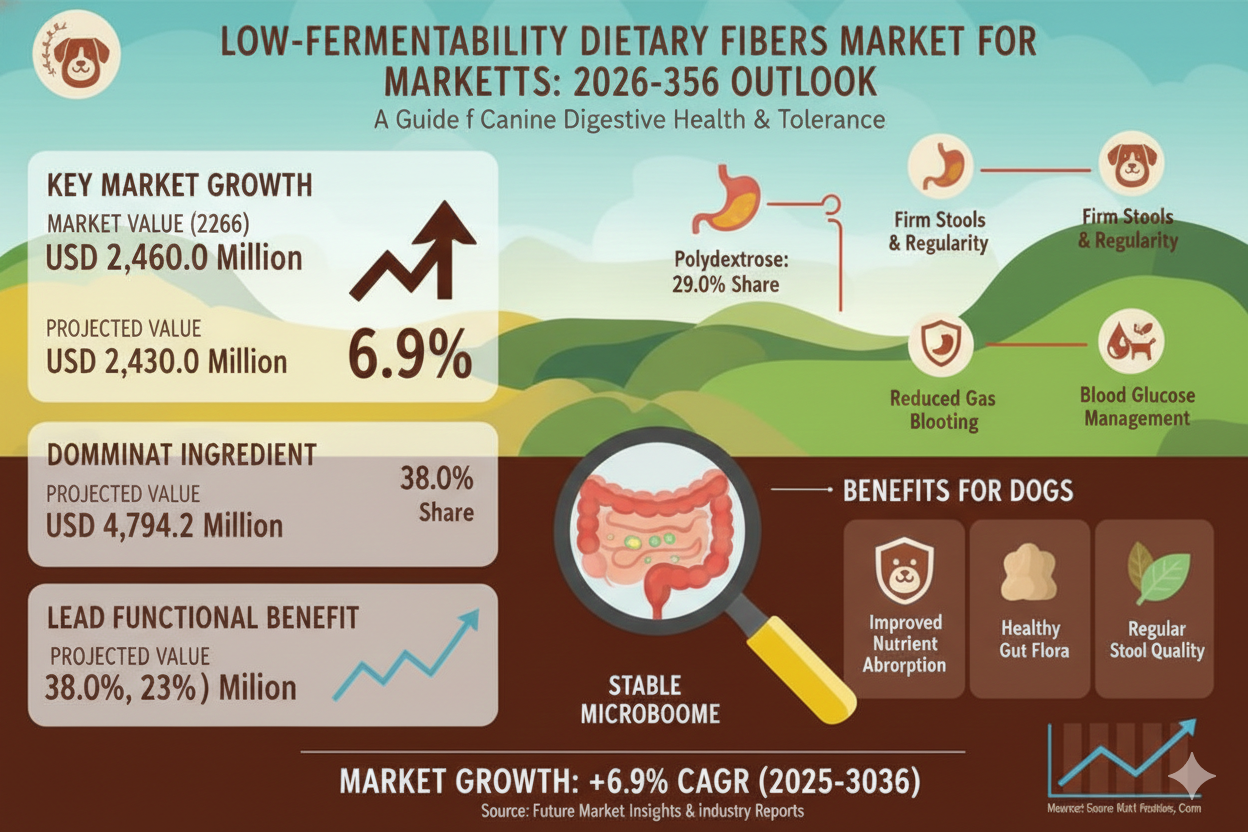
MD, UNITED STATES, January 19, 2026 /EINPresswire.com/ -- Future Market Insights (FMI) has released a comprehensive analysis of the low-fermentability dietary fibers market, highlighting steady growth amid rising consumer focus on digestive health. The market, valued at USD 2,460.0 million in 2026, is forecasted to expand at a compound annual growth rate (CAGR) of 6.9%, reaching USD 4,794.2 million by 2036. This expansion underscores the industry's shift toward fibers that provide essential nutritional benefits without the common side effects associated with traditional fermentable options, such as gas and bloating.
The report examines how low-fermentability dietary fibers—ingredients designed for slower microbial breakdown in the colon—are addressing key challenges in food formulation and consumer wellness. By offering bulking, satiety, and stool normalization while minimizing gastrointestinal discomfort, these fibers are increasingly integrated into everyday products like nutrition bars, meal replacements, fortified beverages, and medical foods. The analysis draws on global and regional data, emphasizing the role of regulatory frameworks, formulation innovations, and market segmentation in driving adoption.
Market Context and Key Insights
In an era where gastrointestinal sensitivity affects millions worldwide, low-fermentability dietary fibers emerge as a practical solution for enhancing fiber intake without compromising digestive tolerance. Unlike conventional fibers that undergo rapid fermentation, leading to discomfort, these alternatives ensure predictable hydration and slower breakdown, making them ideal for consistent daily use. The market's relevance is amplified by growing awareness of gut health, particularly in clinical nutrition, elderly care, sports formulations, and low-FODMAP diets.
Data from the report indicates that polydextrose holds the largest share at 29.0%, prized for its low-impact bulking properties. Resistant dextrin follows at 26.0%, favored for its solubility in beverages and baked goods, while soluble corn fiber accounts for 21.0% due to its clean sensory profile and regulatory acceptance. Cellulose and derivatives contribute 14.0%, providing insoluble structure with minimal fermentation, and other types make up the remaining 10.0%.
From an application perspective, bakery and snacks lead with 32.0% market share, where fiber enrichment must align with texture and taste without digestive drawbacks. Beverages represent 24.0%, demanding high solubility and low gas formation, followed by dairy and dairy alternatives at 18.0% for body enhancement and sugar reduction. Nutritional and functional foods hold 16.0%, focusing on health claims, while dietary supplements comprise 10.0%, emphasizing tolerance-friendly formats.
Regional Growth and Opportunities
Geographically, the market spans Asia Pacific, Europe, North America, Latin America, and the Middle East & Africa, with detailed forecasts for over 40 countries. Emerging economies show the strongest momentum: India leads with an 8.1% CAGR, driven by expanding functional foods and supplements; China follows at 7.8%, fueled by demand in beverages and elderly nutrition; and Brazil at 7.4%, reflecting reformulations for digestive wellness in snacks and dairy alternatives.
In mature markets, the United States anticipates a 6.2% CAGR, supported by clinical and sports nutrition advancements, while the United Kingdom projects 6.0%, aligned with regulatory emphasis on fiber claims. This regional variation highlights opportunities in fiber-enriched drinks and diabetic nutrition in Asia, alongside hospital and weight management products in North America and Latin America.
The report identifies growth drivers such as increasing preference for gut-friendly ingredients amid rising digestive issues, and expansion in medical and low-FODMAP categories. However, restraints include formulation challenges like low solubility in certain fibers, regulatory discrepancies in fiber definitions, and higher processing costs for fermentability suppression. Opportunities lie in integrating these fibers into mainstream portfolios, particularly in emerging markets where clean-label compatibility enhances appeal.
Competitive Landscape and Industry Trends
The competitive environment features key players like Ingredion, Tate & Lyle, Cargill, ADM, and Roquette, who differentiate through tolerance evidence, formulation flexibility, and regulatory expertise. Ingredion leads with a diversified portfolio for digestive comfort, while Tate & Lyle focuses on reduced-sugar optimizations. Cargill integrates fibers with texturizers, ADM emphasizes scalability, and Roquette advances plant-based solutions.
Recent developments include heightened adoption in low-FODMAP and clinical products in the U.S. and U.K., alongside expansions in functional beverages in India and China. Suppliers are refining particle size and water-binding properties for better processing stability, guided by regulations from bodies like the FDA, EFSA, FAO, and WHO on fiber claims and tolerance (notably in 2023-2024).
Request For Sample Report | Customize Report |purchase Full Report: https://www.futuremarketinsights.com/reports/sample/rep-gb-31477
Why This Matters for Industry Stakeholders
For industry leaders, analysts, and investors, this analysis provides actionable insights into a sector poised for innovation. As global fiber intake guidelines evolve—amid recommendations from health organizations—the demand for low-fermentability options addresses compliance barriers in sensitive populations. The report's data-backed forecasts, including a 38.0% share for digestive tolerance improvement in functional benefits, offer a roadmap for strategic investments and product development.
This growth is not isolated; it intersects with trends in sustainable sourcing, clean labeling, and personalized nutrition, positioning low-fermentability dietary fibers as a cornerstone for future food systems. Stakeholders can leverage these findings to navigate regulatory landscapes, optimize formulations, and capitalize on regional expansions.
Explore More Related Studies Published by FMI Research:
Lung Cancer Surgery Market-https://www.futuremarketinsights.com/reports/lung-cancer-surgery-market
Beadlets Capsule Market-https://www.futuremarketinsights.com/reports/beadlets-capsule-market
Demand for Antibody-mediated Rejection Prevention in USA-https://www.futuremarketinsights.com/reports/united-states-antibody-mediated-rejection-prevention-market
Demand for Anti-biofilm Wound Dressing in USA-https://www.futuremarketinsights.com/reports/united-states-anti-biofilm-wound-dressing-market
DKK-1 Biomarker Market-https://www.futuremarketinsights.com/reports/dkk-1-biomarker-market
About Future Market Insights (FMI)
Future Market Insights, Inc. (FMI) is an ESOMAR-certified, ISO 9001:2015 market research and consulting organization, trusted by Fortune 500 clients and global enterprises. With operations in the U.S., UK, India, and Dubai, FMI provides data-backed insights and strategic intelligence across 30+ industries and 1200 markets worldwide.
Why FMI: Decisions that Change Outcomes- https://www.futuremarketinsights.com/why-fmi
Contact Us:
Future Market Insights Inc.
Christiana Corporate, 200 Continental Drive,
Suite 401, Newark, Delaware – 19713, USA
T: +1-347-918-3531
Website: https://www.futuremarketinsights.com
LinkedIn| Twitter| Blogs | YouTube
Have a specific Requirements and Need Assistant on Report Pricing or Limited Budget please contact us - sales@futuremarketinsights.com
Sudip Saha
Future Market Insights Inc.
+1 347-918-3531
email us here
Legal Disclaimer:
EIN Presswire provides this news content "as is" without warranty of any kind. We do not accept any responsibility or liability for the accuracy, content, images, videos, licenses, completeness, legality, or reliability of the information contained in this article. If you have any complaints or copyright issues related to this article, kindly contact the author above.
